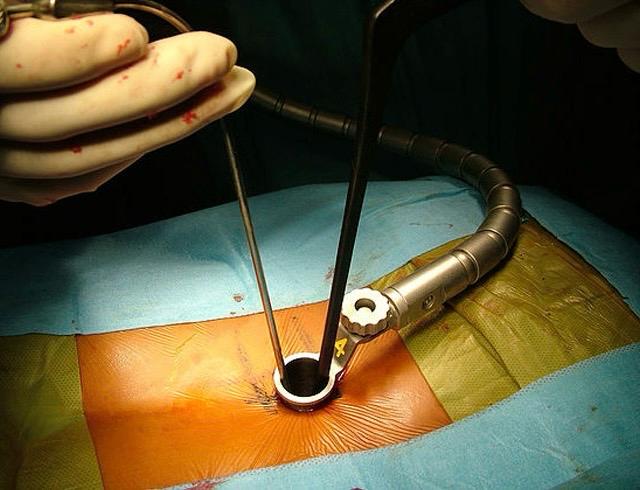
The core principle of MISS is to access spinal pathology through the smallest possible corridor while preserving normal anatomy. This is achieved using tubular retractors, percutaneous instrumentation, muscle-splitting approaches, and endoscopic or microscopic visualization. Rather than wide midline exposures and extensive muscle stripping, MISS relies on sequential dilation and focused exposure, thereby reducing soft tissue trauma, blood loss, and postoperative pain. Image guidance, fluoroscopy, and navigation play a crucial role in ensuring accuracy and safety.
-
Reduced Tissue Trauma and Blood Loss
One of the most important benefits of MISS is reduced disruption of paraspinal muscles and posterior ligamentous structures. Muscle-splitting approaches preserve muscle attachments and vascularity, preventing postoperative muscle atrophy and fibrosis. Consequently, intraoperative blood loss is significantly lower compared to open spine surgery. Reduced blood loss is particularly beneficial in elderly patients and those with medical comorbidities.
-
Decreased Postoperative Pain and Faster Recovery
By minimizing muscle injury and soft tissue dissection, MISS results in less postoperative pain and reduced requirement for opioid analgesics. Early pain relief facilitates faster mobilization and rehabilitation. Most MISS procedures allow early ambulation, shorter hospital stays, and in many cases, day-care surgery. Patients are able to return to daily activities and work earlier, leading to improved quality of life and patient satisfaction.
-
Preservation of Spinal Stability
MISS techniques emphasize preservation of bony and ligamentous structures that are essential for spinal stability. Targeted decompression minimizes unnecessary bone removal and reduces the risk of postoperative instability. In fusion procedures, percutaneous pedicle screw fixation allows stabilization without extensive muscle stripping, maintaining spinal biomechanics and reducing adjacent segment stress.
-
Lower Infection and Complication Rates
Smaller incisions, limited dead space, and reduced operative time contribute to lower rates of surgical site infection in MISS. The reduced physiological stress response also leads to fewer systemic complications such as pulmonary issues and thromboembolic events. Studies have demonstrated comparable or lower complication rates for MISS when compared with conventional open spine surgery, particularly when performed by experienced surgeons.
-
Applicability Across a Broad Spectrum of Pathologies
Minimally invasive techniques are now widely used in the treatment of lumbar disc herniation, spinal stenosis, spondylolisthesis, vertebral fractures, spinal infections, and deformity correction. MISS approaches such as minimally invasive transforaminal lumbar interbody fusion (MIS-TLIF), percutaneous pedicle screw fixation, tubular decompression, and endoscopic spine surgery have become standard options in modern spine practice. Cervical and thoracic applications have also expanded with favorable outcomes.
-
Advantages in High-Risk and Elderly Patients
MISS is particularly advantageous in elderly patients and those with significant comorbidities. Reduced blood loss, shorter anesthesia time, and early mobilization decrease perioperative risks. Many procedures can be performed with regional anesthesia or shorter-duration general anesthesia, further enhancing safety in high-risk populations.
-
Learning Curve and Technological Dependence
Despite its advantages, MISS has a steep learning curve and requires specialized training and equipment. Surgeons must develop proficiency in working through limited corridors with indirect visualization and reliance on imaging guidance. However, with appropriate training and experience, clinical outcomes are comparable or superior to open techniques.
-
Economic and Healthcare System Benefits
Although initial setup costs for MISS may be higher, overall healthcare expenditure is often reduced due to shorter hospital stays, fewer complications, and faster return to work. From a societal perspective, MISS offers significant economic advantages by minimizing productivity loss and long-term disability.
Conclusion
Minimally invasive spine surgery represents a significant advancement in spinal care, balancing effective surgical intervention with maximal preservation of normal anatomy. By reducing tissue trauma, postoperative pain, and recovery time while maintaining clinical efficacy, MISS has redefined patient-centered spine surgery. As technology evolves and surgical expertise continues to grow, minimally invasive techniques are likely to remain integral to the future of spine surgery, offering safer and more efficient treatment options for a wide range of spinal disorders.